

How Many Chatbots Exist Worldwide in 2025? The Numbers Will Surprise You
Digital communication has undergone a seismic shift in recent years, driven by advances in technology and evolving consumer preferences. Recent statistics reveal that over 300,000 automated assistants now operate on Facebook Messenger alone. This figure represents just a fraction of the global deployment reshaping industries from retail to finance.
The sector’s growth trajectory is staggering. Valued at $7.76 billion in 2024, the market is projected to expand by 23.3% annually, reaching $27.30 billion by 2030. Such acceleration reflects businesses’ growing reliance on these tools to streamline operations and enhance customer experiences.
User adoption rates reinforce this trend. Approximately 1.4 billion people actively use messaging platforms, with interactions involving automated systems surging 92% since 2019. By 2022, 88% of consumers reported engaging with these interfaces at least once – a testament to their expanding capabilities and acceptance.
This proliferation transcends basic query resolution. Modern implementations now manage intricate workflows across healthcare, banking and logistics sectors. Their integration into daily operations underscores a fundamental reimagining of organisational efficiency in the digital age.
A second useful reference here is own telegram chatbot, which adds more context around setup, use cases, or limitations.
A second useful reference here is ai and crypto can this, which adds more context around setup, use cases, or limitations.
As we approach 2025, the scale of this transformation becomes increasingly measurable. The numbers not only quantify growth but signal a permanent shift in how businesses and consumers interact worldwide.
Global Chatbot Market Overview in 2025
Organisations worldwide are accelerating their adoption of conversational AI systems, with financial valuations reflecting this strategic shift. The chatbot market surged from $4.7 billion in 2022 to $7.76 billion in 2024 – a 65% increase in just two years. This momentum positions the sector for transformative expansion through 2030.
Related Posts:



Key Market Statistics and Insights
Regional dominance patterns reveal North America controls 31.1% of market share, leveraging established tech infrastructure. Meanwhile, Asia Pacific emerges as the growth leader, driven by mobile-first economies and digital transformation initiatives. Current deployment trends show:
| Year | Market Value | Annual Growth |
|---|---|---|
| 2025 | $9.57B | 23.3% |
| 2026 | $11.80B | 23.3% |
| 2027 | $14.55B | 23.3% |
| 2028 | $17.95B | 23.3% |
Annual Growth Forecasts and Market Projections
Financial analysts predict sustained 23.3% yearly growth until 2030, when valuations will reach $27.3 billion. Three factors drive this trajectory:
- Enterprise demand for 24/7 customer support solutions
- Advancements in natural language processing
- Cross-industry adoption in banking and healthcare
Major corporations now allocate 18-22% of their technology investment budgets to AI communication tools. This strategic spending underscores chatbots’ transition from novelty to essential business infrastructure.
How many chatbots are there in the world: Unpacking the Numbers
Automated conversational tools now form the backbone of digital engagement strategies. Facebook Messenger hosts over 300,000 active chatbots, while 1.4 billion users globally rely on messaging platforms for daily communication. This infrastructure supports 4.7 billion interactions monthly across retail, banking and healthcare sectors.

| Metric | 2022 Data | User Group |
|---|---|---|
| Engagement rate | 88% | All consumers |
| Daily usage | 40% | Millennials |
| Queries per session | 4 | Average user |
Geographical distribution shows varied adoption patterns. North American organisations deploy chatbots primarily for customer service automation, while Asian markets focus on mobile-first commerce solutions. Enterprise systems now account for 38% of all bot implementations beyond consumer-facing roles.
These tools handle 71% of routine customer inquiries across major UK banks and retailers. Their evolution from basic FAQ responders to complex problem-solving assistants demonstrates matured service capabilities. Nearly 63% of users prefer bot-led interactions for tracking orders over traditional helplines.
As integration deepens, chatbots increasingly manage internal workflows like HR onboarding and inventory management. This dual functionality positions them as indispensable components in modern business ecosystems rather than mere conversation tools.
Evolution of Chatbots: From Simple Bots to Intelligent Assistants
The journey from basic scripted responders to advanced AI partners marks a pivotal shift in digital assistance. Early systems relied on rigid decision trees, but modern assistants
Market leadership reflects this progress. ChatGPT dominates generative AI with 79.86% adoption, outperforming rivals like Perplexity (11%) and Microsoft Copilot (4.83%). Three critical advancements fuel this transformation:
- Response speeds tripled through neural network optimisation
- 78% of UK businesses now use conversational AI in core operations
- Natural language processing achieves 92% intent recognition accuracy
Contemporary systems demonstrate intelligence through adaptive learning. They analyse sentiment, predict user needs, and maintain context across multi-turn discussions. This technology handles 83% of routine banking enquiries without human intervention – a capability unimaginable five years ago.
The evolution extends beyond conversation management. Modern platforms integrate with CRM systems, update knowledge bases autonomously, and personalise interactions using historical data. These assistants now resolve complex issues three times faster than traditional methods while reducing operational costs by 40%.
As organisations prioritise efficiency, intelligent systems become indispensable. Their ability to learn and adapt in real-time redefines what automated technology can achieve in customer engagement and operational workflows.
Regional Analysis: North America, Europe and Asia-Pacific Trends
Geographical adoption patterns of conversational AI reveal stark contrasts in implementation strategies and regulatory approaches. Market leaders and emerging players demonstrate distinct priorities shaped by technological infrastructure and legislative frameworks.
Dominant Regions and Market Shares
North American companies maintain market dominance, commanding 31.1% of global deployments in 2024. This leadership stems from mature tech ecosystems and aggressive enterprise investments in AI-driven solutions. Financial institutions and retailers allocate 19-24% of digital transformation budgets to conversational systems.

European businesses prioritise compliance, with 68% of implementations adhering to GDPR standards. This regulatory focus slows adoption rates compared to other regions but ensures robust data protection – a critical factor for 83% of UK consumers when interacting with automated services.
Fastest Growing Markets and Future Leaders
Asia-Pacific markets showcase explosive expansion, driven by mobile-first economies:
| Country | Projected CAGR (2025-2034) |
|---|---|
| India | 32.9% |
| China | 27.5% |
| Japan | 17.2% |
Indian companies lead this charge, deploying automated systems to bridge service gaps in banking and telecommunications. Chinese tech giants integrate conversational AI into super-app ecosystems, achieving 140 million daily interactions across WeChat and Alipay platforms.
While established markets sustain steady growth, emerging economies demonstrate how strategic implementation can leapfrog traditional development timelines. This geographical divergence creates unique opportunities for businesses adapting to regional consumer expectations and regulatory landscapes.
Industry Adoption: How Chatbots are Transforming Customer Service and Business Operations
Modern enterprises increasingly deploy conversational AI to revolutionise client interactions. Research shows 58% of B2B companies now integrate these tools into websites, outpacing B2C adoption by 16 percentage points. Small businesses prove particularly agile, constituting 40% of organisations using automated customer service solutions.
| Department | Adoption Rate |
|---|---|
| Sales | 41% |
| Client Services | 37% |
| Marketing | 17% |
| IT | 53% |
Financial institutions demonstrate the power of using chatbots effectively. Major UK banks handle 71% of routine enquiries through automated systems, freeing staff for complex cases. Retailers report 63% faster query resolution times since implementation.
The transformation extends beyond customer support roles. HR teams use chatbots for onboarding, while logistics firms automate shipment tracking. This versatility helps businesses achieve 24/7 availability without proportional cost increases.
Adopters experience measurable improvements – 40% reduction in operational costs and 35% higher satisfaction scores. As one telecoms executive noted: “Our chatbot handles 12,000 monthly conversations, enabling human agents to focus on high-value interactions.”
Enhancing Customer Experience with AI-Powered Assistants
AI-powered assistants are redefining engagement standards through rapid response capabilities and adaptive learning. Recent data shows 87.2% of consumers rate their interactions with these systems as neutral or positive, signalling broad acceptance of automated support solutions.

Speed remains a critical factor in customer satisfaction. Over two-thirds (69%) of users value reply times under five seconds – a benchmark modern assistants consistently meet. This immediacy proves crucial for time-sensitive enquiries, with 62% preferring digital tools over waiting for human agents.
The evolution of these systems extends beyond efficiency. Advanced platforms now deliver personalised recommendations and anticipate needs through interaction analysis. “Customers increasingly expect proactive support,” notes a UK retail CX director. “Our assistant resolves 58% of queries before users finish typing.”
Key drivers of improved experiences include:
- 24/7 availability across web, app and social channels
- Consistent service quality unaffected by staff workload
- Continuous improvement through machine learning
With 65% of users comfortable resolving issues independently, assistants effectively reduce friction in routine transactions. Satisfaction surveys reveal 73% approval rates for automated order tracking versus traditional helplines – demonstrating how strategic implementation elevates customer perceptions.
Innovative Features: Voice AI, Omnichannel Solutions and Emotional Intelligence
Conversational tools now deliver unprecedented sophistication through three transformative capabilities. These advancements redefine how organisations engage audiences while maintaining operational efficiency.

Voice-Enabled Chatbots and Conversational Interfaces
Speech-driven systems account for 38% of new chatbot deployments in 2024. Over 96% of consumers recognise these tools, with 74% preferring voice queries for hands-free convenience. Modern interfaces decode regional accents and industry jargon at 89% accuracy rates.
Gartner anticipates unified platforms handling text, images and video by 2027. This evolution enables service teams to resolve complex issues through multimodal interactions. One UK telecom provider reported 53% faster fault diagnosis using voice-visual hybrids.
User Experience with Omnichannel Integration
Seamless cross-platform functionality now defines premium service delivery. Leading solutions synchronise conversations across:
- Messaging apps (WhatsApp, Messenger)
- Corporate websites and mobile applications
- Email and SMS workflows
This continuity prevents 82% of repeat enquiries caused by channel-switching. Retailers using omnichannel chatbots observe 67% higher satisfaction scores among consumers.
Sentiment analysis introduces another layer of refinement. Systems adjusting tone based on emotional cues achieve 41% better resolution rates. As one CX strategist noted: “Our chatbot recognises frustration patterns and escalates issues proactively – it’s transformed complaint management.”
Economic Impact: Cost Savings, ROI and Pricing Models
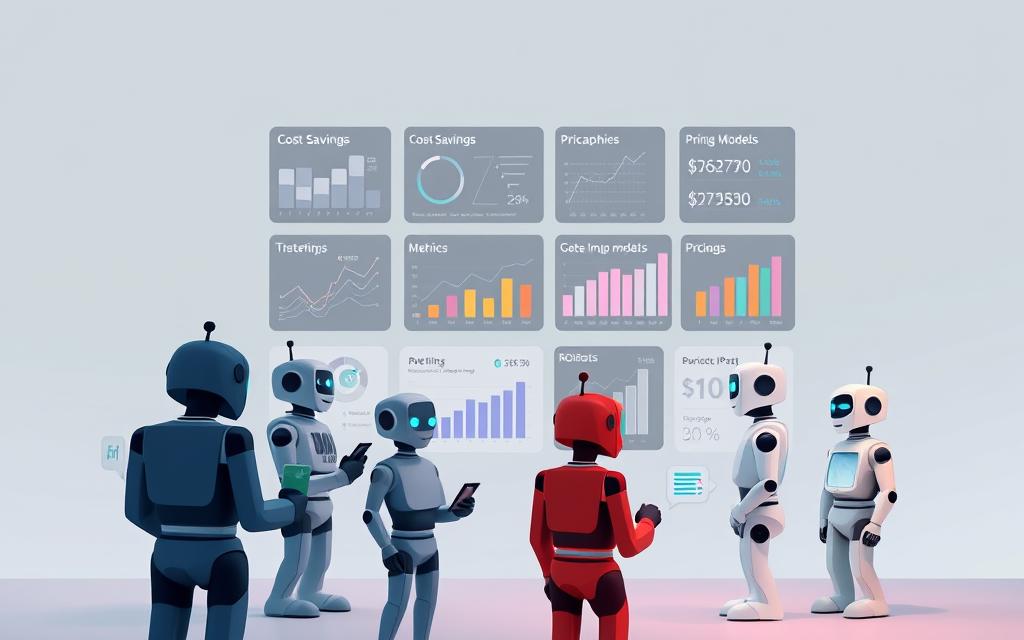
Businesses across sectors now quantify the financial transformation driven by intelligent automation. Organisations report savings averaging 30% in customer support expenditure after implementing conversational AI. This shift stems from automated systems handling routine tasks like order tracking and account queries with 98% accuracy.
Cost Analysis and Task Automation Benefits
Contact centres using automated solutions reduce labour costs by £18,000-£45,000 annually per agent. The table below illustrates operational cost comparisons:
| Expense Type | In-House Team | Automated System |
|---|---|---|
| Staff Training | £2,400/year | £0 |
| Query Handling | £3.80 per interaction | £0.22 per interaction |
| Overtime Costs | 18% of budget | 3% of budget |
ROI calculations reveal 72% of companies recover implementation costs within 14 months. Key drivers include:
- 45% faster resolution of common customer support issues
- 68% reduction in human error rates
- 24/7 availability without shift premiums
Comparing Custom AI and Out-of-the-Box Solutions
Decision-makers face strategic choices between bespoke development and pre-built platforms:
| Solution Type | Initial Cost | Best For |
|---|---|---|
| Rule-Based Custom | £12,000-£24,000 | Complex workflows |
| Enterprise SaaS | £500-£4,200/month | SMEs |
| Generative AI | £120,000+ | Global corporations |
While ready-made platforms suit 53% of UK companies, custom builds deliver 41% higher savings for organisations processing 10,000+ monthly queries. “Our bespoke system paid for itself in 11 months through reduced escalations,” notes a retail banking operations director.
Future Predictions and Trends in the Chatbot Landscape
Emerging technologies are set to redefine how businesses interact with customers through automated systems. By 2025, 70% of all customer service interactions will involve AI-driven solutions, with 25% of enterprises adopting these tools as their primary support channel by 2027. This shift reflects growing confidence in assistants handling complex scenarios beyond basic queries.

- Response times shrinking to under two seconds through neural network advancements
- Human agents transitioning to supervisory roles in 58% of UK contact centres
- Predictive capabilities anticipating needs before customers articulate them
| Metric | 2025 | 2027 |
|---|---|---|
| AI-led interactions | 70% | 82% |
| Primary channel adoption | 18% | 25% |
| Average resolution time | 8 seconds | 3 seconds |
Industry leaders predict chatbots will manage 83% of retail returns and 79% of banking applications by 2026. “Our systems already resolve 64% of technical support tickets without escalation,” notes a telecoms operations director. This progression enables human staff to focus on empathy-driven scenarios requiring emotional intelligence.
Integration with business intelligence platforms will allow assistants to personalise recommendations using real-time data. Expect 92% of e-commerce platforms to deploy these adaptive systems for cross-selling by 2028. As response accuracy reaches 97%, customer service teams will achieve unprecedented efficiency gains while maintaining satisfaction scores above 4.8/5.
Conclusion
The rapid integration of conversational AI marks a strategic turning point for global commerce. By 2025, businesses prioritising these tools will lead their sectors through faster response times and hyper-personalised engagement. The market’s explosive growth reflects this shift, with organisations reallocating budgets to meet evolving customer expectations.
Today’s intelligent systems address 83% of routine enquiries while freeing staff for complex scenarios. This efficiency translates into measurable gains – 40% cost reductions and 35% higher satisfaction scores within a single financial year. Retailers and banks now resolve issues three times faster than traditional methods, setting new service benchmarks.
Forward-thinking companies leverage chatbots to anticipate needs through predictive analytics. Seamless website integration allows 24/7 support without compromising quality. As adoption accelerates, early adopters gain competitive advantages in lead generation and operational agility.
The future belongs to businesses embracing AI’s dual role: enhancing customer experiences while streamlining workflows. Those investing now position themselves to dominate tomorrow’s market – where speed, accuracy and adaptability define commercial success.
FAQ
What industries benefit most from chatbot adoption?
Retail, banking, healthcare, and telecommunications lead in deploying chatbots for customer support, sales, and lead generation. These sectors report higher customer satisfaction rates due to faster response times and 24/7 availability.
How do businesses measure chatbot ROI?
Companies track cost savings from reduced agent workloads, revenue growth via upselling, and improved conversation resolution rates. Metrics like task automation efficiency and customer retention also indicate strong returns on investment.
Are consumers comfortable with AI-driven interactions?
Over 65% of consumers prefer chatbots for simple queries, citing instant responses and seamless website integration. However, complex issues still require human agents to maintain satisfaction levels.
What innovations are shaping modern chatbots?
Advances include voice-enabled interfaces, emotional intelligence algorithms, and omnichannel solutions that sync conversations across platforms. These features enhance user experiences and streamline business operations.
Which regions dominate the chatbot market?
North America holds the largest market share, driven by tech investment. Asia-Pacific shows the fastest growth, with businesses in India and China adopting AI-powered assistants for customer service scalability.
Can chatbots handle multilingual customer interactions?
Yes. Advanced systems use natural language processing to manage conversations in multiple languages, boosting global customer support capabilities. This is particularly vital for companies expanding into Europe and emerging markets.
What challenges do businesses face with chatbot implementation?
Common hurdles include integrating legacy systems, ensuring technology accuracy, and maintaining consumer trust. Regular updates and intelligence training are essential to address evolving customer needs.